
inDrive plans robotaxi tests. Who is in control when the ride goes wrong?
Prepared by the POLONICO.INFO AI newsroom from the source below.
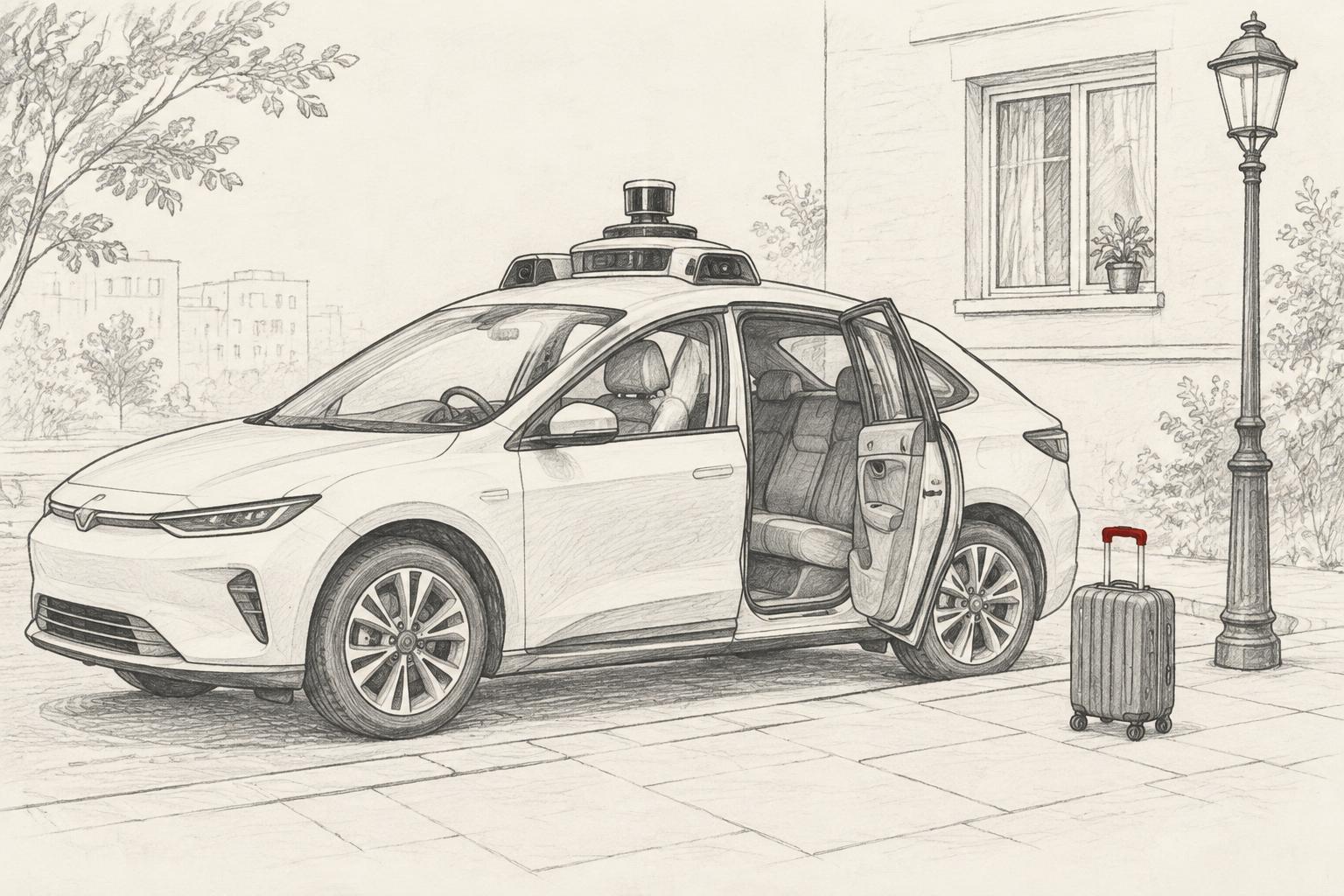
Plans for supervised tests in Astana deserve more than excitement. Waymo’s circling ride and the Cruise pedestrian incident show why passenger control, emergency response and honest reporting must be tested before promises become a service.
A driverless car does not remove responsibility. It removes the person a passenger can immediately tell to stop. The inDrive, Pony.ai and NVIDIA announcement should therefore be judged not by the partners’ prestige, but by what happens after the first mistake. Other operators’ experiences offer concrete reasons to ask about more than convenience.
First, a correction that also matters for our previous article: this is not an announcement of a ready-to-use driverless service. In its October 23, 2026 statement, inDrive describes an agreement to explore autonomous ride-hailing in Kazakhstan. Its CTO told TechCrunch that tests in Astana are planned for the first half of 2027, initially with a safety operator. Fully driverless rides are a goal, not an established service.
A Waymo ride on December 9, 2024 illustrates a routing failure. Mike Johns was travelling to the airport from Scottsdale when the car repeatedly circled a parking lot. NBC News reported Waymo’s account that the episode lasted about five minutes. Johns said he could not get out. That is not proof of malfunctioning locks: the car was moving. He eventually reached the airport and caught his flight. Waymo did not charge him and said a software update resolved the issue. The practical question remains: why could the customer not simply end the pointless ride?
There are also accounts involving doors. Maeil Business Newspaper journalist Won Hoseob described a December 12, 2025 journey to Sunnyvale after which his door would not open. In his account, support suggested trying the outside handle, but that did not help; he exited through another door. This is one passenger’s firsthand report, not a regulator’s finding or evidence that every exit was blocked. It nevertheless raises an accessibility question: an emergency procedure must work for someone unable to climb across the seats.
A much more serious incident involved Cruise in San Francisco on October 2, 2023. Another vehicle first struck a pedestrian and threw her into the robotaxi’s path. After the collision, Cruise attempted a pull-over, dragging her beneath the vehicle for about 20 feet. NHTSA documented the dragging and announced a $1.5 million penalty in September 2024 for incomplete crash reporting, including omission of those post-crash details. California’s DMV had already suspended Cruise’s driverless testing and deployment permits. The injured person was a pedestrian, not a passenger. The issue concerned both machine behaviour and whether the company fully disclosed its failure.
These incidents involved Waymo and Cruise, not Pony.ai. They do not establish defects in the proposed Kazakhstan service or prove that robotaxis as a group are less safe than human drivers. Such a verdict would require comparable exposure, operating conditions and crash data. They do show that a car driving itself is not the same as its passenger retaining control, and that safety assurances are no substitute for independent scrutiny.
Before launch, inDrive and Pony.ai should demonstrate how a passenger stops a mistaken journey, exits safely and reaches a human quickly. What if the car passes the destination or stops somewhere unsafe? How does a person with limited mobility get help? Who handles an accident and receives the complete incident record? The announcement does not provide enough evidence to evaluate those procedures. That is an evidence gap, not proof of a concealed defect.
Market scale also needs careful definitions. On August 12, 2025, Pony.ai said it had produced more than 200 seventh-generation robotaxis. In its November 2025 results release, it reported a fleet of 961 robotaxis, including 667 Gen-7 vehicles. These numbers cannot be added together: one measures earlier production, the other later fleet inventory spanning generations. Neither establishes how many vehicles were carrying paying passengers at a given moment. Both are company disclosures, not an independent audit.
The United States is not waiting for Kazakhstan. Alphabet’s Waymo runs paid services in areas including Phoenix, San Francisco and Los Angeles; Austin and Atlanta are served through Uber. In March 2026, TechCrunch cited 3,067 vehicles equipped with Waymo’s fifth-generation system as of December 2025, and Waymo’s March description of more than 3,000 vehicles. That benchmarks fleet inventory, not vehicles newly manufactured in a year or simultaneously available to customers. The comparison with Pony.ai indicates thousands rather than millions of cars, but different dates and scopes prevent an honest market-share calculation.
China is central, not peripheral. On November 6, 2025, Pony.ai announced commercial driverless Gen-7 services in Guangzhou, Shenzhen and Beijing. Another major player is Baidu’s Apollo Go: in May 2025 management reported about 1,000 robotaxis globally and more than 11 million cumulative orders. Millions of trips do not mean millions of cars. These historical figures indicate operating experience, not a current independently verified census of China’s robotaxis. Nor can results from one city simply be assumed to hold in Astana.
Who is behind the technology? Pony.ai was founded in Fremont, California, in 2016 by James Peng and Tiancheng Lou, with earlier Google and Baidu connections. It developed substantial Chinese operations; a Nasdaq listing does not make it simply an American operator. Reuters reported Toyota’s 13.4% stake in October 2024—a historical figure, not a verified October 2026 holding—and identified HongShan among its backers. Ownership deserves specific investigation. An American listing is not proof of American control, and Chinese origins are not proof of misconduct.
Money is central to the partnership. The announcement assigns the app and service operation to inDrive, the vehicles to Pony.ai and technology infrastructure to NVIDIA. Each has an interest in expansion: the platform in ride revenue, the autonomy supplier in commercialising its technology, and the infrastructure supplier in selling its products. That is an analysis of their roles, not evidence of an agreed profit split. The announcement does not disclose tariffs, fleet costs, margins or partner payments, and it does not establish an NVIDIA equity investment in this operation. Removing a driver does not remove vehicle, maintenance, insurance or remote human-support costs. Lower customer fares cannot be assumed.
Chinese and American partners also make data governance a practical question. Who controls recordings and journey histories? Will data leave Kazakhstan, where would it go, and under what authority? Which entity gives local regulators a complete accident record, and which answers passenger complaints? The cited material does not settle these questions. We do not imply an undocumented transfer; we ask for the information needed to assess who actually controls the service.
Our conclusion: supervised testing is a more defensible starting point than advertising finished autonomy. But a pilot’s safety operator may solve problems that become the passenger’s burden once that operator disappears. The meaningful test is not a polished demonstration ride. It is a transparent account of what happens when the car makes a mistake—and whether a person can regain control.
DIGITAL FREEDOM IMPACT
Freedom of movement includes the ability to end a journey safely and obtain human help. Other operators’ documented incidents justify scrutiny of passenger control but do not establish defects in Pony.ai. Oversight should include independent assessment of emergency procedures and complete incident reporting.
Tools related to this article
Gemini
General agent – Google's assistant integrated with Gmail, Docs and Search.
Free + paid plans
Visit supplierOllama
Local AI – runs open models on your own computer, without sending data to the cloud.
Free
Visit supplierMatched automatically to the story's content. Commissions never affect news selection. Compare AI tools
Sources
- inDrive — komunikat, 23 October 2026 (publisher-supplied)
- TechCrunch — plan testów z operatorem (publisher-supplied)
- NBC News — kurs Waymo w kółko (publisher-supplied)
- Maeil Business Newspaper — relacja pasażera o drzwiach (publisher-supplied)
- NHTSA — ustalenia i kara za raportowanie Cruise (publisher-supplied)
- California DMV — zawieszenie zezwoleń Cruise (publisher-supplied)
- Pony.ai — produkcja ponad 200 Gen-7, August 2025 (publisher-supplied)
- Pony.ai — flota i wyniki, November 2025 (publisher-supplied)
- Pony.ai — usługi w trzech chińskich miastach (publisher-supplied)
- TechCrunch — skala floty Waymo, March 2026 (publisher-supplied)
- Waymo — rynki usług (publisher-supplied)
- CNEVPost — Apollo Go, May 2025 (publisher-supplied)
- Pony.ai — historia firmy (publisher-supplied)
- Reuters — Toyota i właściciele Pony.ai, October 2024 (publisher-supplied)
AI Spotlight
I Tested Every Major AI Agent for a Day. Here’s the Best One
WIRED AI · 2026-10-27
Cohere says Alibaba’s Qwen model tried to send a file to Beijing
TechCrunch AI · 2026-10-27
OpenAI announces three big science discoveries and a new way to work with academics
The Verge AI · 2026-10-26
GPT-6.1 Terra halves OpenAI's API prices and still gains ground on its larger models
The Decoder · 2026-10-26